5-Second Daily Exercise Every Busy Woman Can Do
Why 5 Seconds Matter for Women’s Wellness? When life accelerates—as it so often does for modern women juggling careers, family, and home care—finding even 5 seconds to do something meaningful makes a difference. We often think exercise must take 30 minutes or more, but emerging trends show that micro-moves can accumulate into real wellness gains. According to recent health coverage, one simple 5-second exercise is being recommended for women to strengthen key muscle groups.
This shift towards “tiny habits” is part of a larger women’s wellness wave. From holistic mind-body routines to quick interventions, the message is clear: you don’t need huge chunks of time to take care of yourself.
By embracing one 5-second daily move, you step into a pathway of consistency, not perfection. You honour your body, your time, and your commitments all at once.
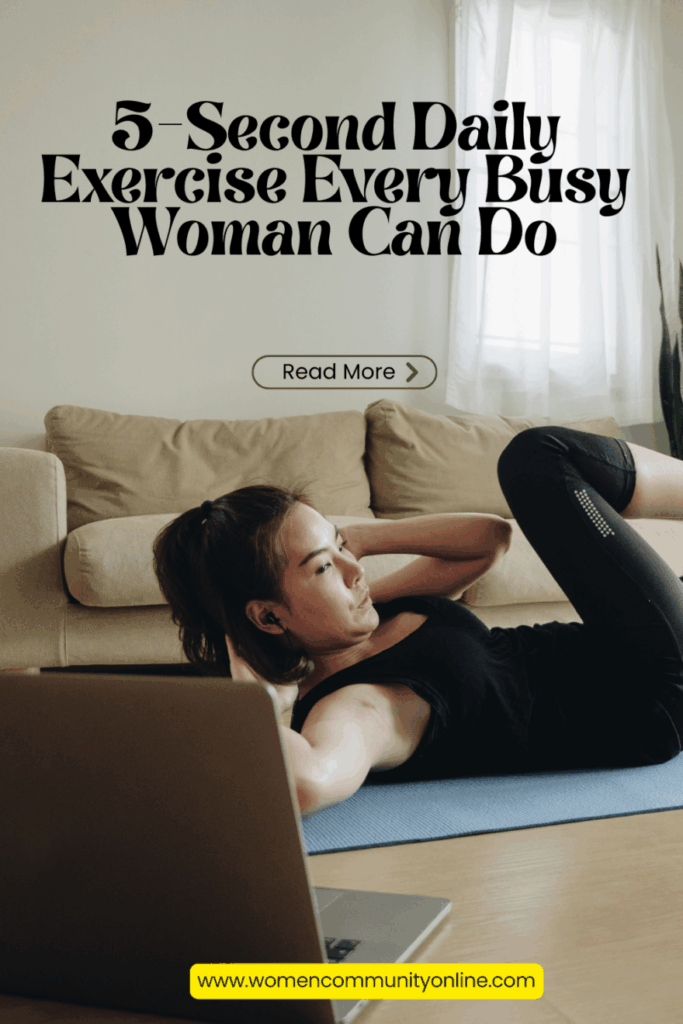
What Is the 5-Second Exercise?
So what exactly is this 5-second-daily exercise for women? The focus is on a targeted pelvic-floor contraction, sometimes known as a “Kegel” style move, that you can perform briefly but frequently. It may seem small — but consistency is the secret.
Here’s how it works: find a comfortable position (sitting, standing or lying down), engage the pelvic floor muscles for about 5 seconds, then relax for a similar amount of time. Repeat several times across the day. Because it’s short, you can slip it into almost any moment: waiting for the kettle, during a meeting, while in the car (at a stop) or doing chores.
Think of it as micro-wellness: small investment, scalable payoff. The strategy is particularly practical for women with tight schedules, caregiving roles, or those returning to activity after a pause.
Why Busy Women Love It
One major reason busy women are gravitating toward this 5-second exercise is time efficiency. If you’re answering emails, managing home errands, parenting, or balancing multiple roles, you might feel there’s “no time” for a standard workout. This micro-move changes the narrative: even when you don’t have time, you can do something.
Secondly, the move is discreet and adaptable. You don’t need special equipment, gym clothes, or a dedicated space. You carry it with you through your day. That adaptability reduces friction and increases the chance you’ll actually do it.
Finally, it taps into the rising trend of women’s empowerment via self-care, where small consistent acts build big changes. Women are seeking practical, sustainable routines—not just ambitious one-off pledges.
The Science Behind It (and What it Helps)
Let’s dive a little into the science. The pelvic floor muscles play a key role in core stability, bladder control, posture and even sexual health. Strengthening them helps women regain control and feel stronger. The news piece referenced earlier emphasised the importance of this muscle group.
Over time, consistent micro-contractions can lead to improved muscle tone, reduced fatigue, better posture and enhanced body awareness. Plus, the psychological lift of doing something every day (even if small) boosts confidence and momentum. That “I did my move” feeling becomes the gateway to more positive wellness habits.
This aligns with broader wellness research showing that personalized, frequent, short interactions (rather than infrequent large efforts) are the new frontier.
How to Build Your 5-Second Habit (Step-by-Step)
Step 1: Choose your cue
Pick a daily anchor moment: waking up, brushing your teeth, before dinner, after a call, or at bedtime. Consistency is key.
Step 2: Perform the move
Sit or stand comfortably. Tighten your pelvic-floor muscles for 5 seconds (keep breathing!), then relax for about 5 seconds. Repeat 3–5 times.
Step 3: Track lightly
Use a check-box or mental tally: did you do it? This simple recording increases accountability.
Step 4: Celebrate micro-wins
Even though it’s just 5 seconds, acknowledge the win — you showed up. That positive reinforcement builds momentum toward other healthy choices.
Step 5: Scale if you like
Once it’s habitual, consider increasing to 10 seconds or adding 2 sets. But only if your schedule allows and you feel comfortable.
By following these simple steps, you turn a “should do” into a “did do” habit — one that fits your lifestyle, not competes with it.
Everyday Moments to Slip It In
You don’t need to schedule extra time; you simply weave this 5-second move into what you already do. Here are some real-life instances:
While your morning coffee brews: sit at your kitchen counter, tighten for 5 seconds, release.
During a conference call: sit upright, engage pelvic-floor just before you speak, then relax.
After you park the car: before stepping out, engage once.
While waiting for your child to finish homework: use that pause.
Before you get into bed: do it as part of your wind-down routine.
By embedding it into existing routines, you reduce resistance and make the habit sticky. This strategy aligns with habit-formation science: inserting a new action into an old routine.
What to Expect & How to Progress
In the first week, expect to simply notice the move. Some days you’ll remember, others not — that’s okay. The goal is repetition, not perfection.
By week 2–4, you may feel subtle changes: improved posture when sitting, a brief awareness of core stability, maybe even more comfort during everyday tasks.
By weeks 4–8, many women report a stronger pelvic‐floor sense, less fatigue, maybe fewer bladder “oops” moments, or just a general feeling of being more “anchored” in their body.
If you feel comfortable and want to progress: increase hold time to 10 seconds, add another set, or pair with a 30-second plank or similar move. But only when it feels manageable — the key is consistency over intensity.
Common Mistakes & How to Avoid Them
Mistake 1: Skipping because “I’m too busy”.
Solution: Remember: 5 seconds doesn’t compete with your schedule — it fits it. Choose a built-in cue.
Mistake 2: Holding your breath or using other muscles (butt, thighs, belly) instead of pelvic floor.
Solution: Breathe normally. Focus on the lift/squeeze at the base of your pelvis. If unsure, imagine stopping the flow of urine mid-stream (for educational purposes only).
Mistake 3: Doing it inconsistently — “I’ll do tomorrow” syndrome.
Solution: Use a habit tracking method. Mark a calendar or use an app reminder at your cue time.
Mistake 4: Jumping ahead too fast.
Solution: Don’t increase hold time or sets until the 5-second move is comfortably embedded. Otherwise you risk burnout or injury.
By avoiding these mistakes, you safeguard the habit and invite sustainable change.
Complementary Lifestyle Moves for Women’s Holistic Wellness
While the 5-second exercise is a fantastic entry point, pairing it with other lifestyle habits amplifies the benefit.
Sleep hygiene: Quality sleep supports muscle recovery, hormone balance and mood. Women’s wellness research frequently highlights rest as foundational.
hotbot.com
Mind-body breaks: Even a 2-minute breathing exercise or stretch can elevate your daily routine.
Nutrition: Fuel your body with balanced meals that support muscle, energy and recovery.
Hydration: Dehydration can undermine even small exercise efforts.
Movement variety: As you build strength and consistency, consider adding short walks, gentle yoga or body-weight circuits — but only as your schedule allows.
By layering these habits, you shift from “micro-move” to “micro-movement ecosystem” — a sustainable framework for long-term wellness.
Real Women, Real Results & Mindset Shift
Consider this: many women remember times when they couldn’t find 30 minutes for a workout. Then they try this 5-second move and realise: “Actually, I can do something.” That realisation matters.
One woman told the journalist:
“Between completing work hours, doing household chores and spending time with family, there’s not much of the day left for me. Doing this 5-second move made me feel… like I’m still taking care of myself.”
This mindset shift — from “I don’t have time” to “I have time for this” — is perhaps the most powerful part. Because once you believe you can, you’re more likely to look for the next positive choice: maybe a 10-second hold, maybe a 5-minute walk, maybe a deeper breathing session.
Remember: it’s not about perfection. It’s about progress. Every mini-move counts. Every daily commitment strengthens your body, your self-respect, your habits. And you deserve that.